

Quick answer: When hiring a HubSpot expert, prioritize Hub-specific depth over generalist claims—someone who's built workflows in Marketing Hub is not the same person who architects custom objects in Sales Hub or CRM. Start by identifying whether your problem is tactical (single Hub, defined tasks) or strategic (cross-Hub, pipeline-connected), then match the expert type: freelance admin, certified consultant, fractional RevOps strategist, integration specialist, or full agency partner. The right type depends on your problem, not your budget.
Disclosure before we go further: Vaulted is a HubSpot Solutions Partner. We've implemented HubSpot for 150+ organizations. We have a financial stake in how this conversation plays out—and we're going to be honest about when you don't need us, or anyone like us.
Most content about hiring a HubSpot expert falls into two predictable camps. Agency blogs tell you that you need an agency. Freelance marketplace content tells you that you need a freelancer. Neither is honest, because neither asks the question that actually matters: what kind of help do you need?
The term "HubSpot expert" covers at least five materially different roles. A freelance admin managing your email templates and a fractional RevOps strategist redesigning your lifecycle stages are both called "HubSpot experts" on LinkedIn. They solve fundamentally different problems at fundamentally different price points with fundamentally different accountability structures.
This post helps you figure out which type fits your situation—and gives you a framework to evaluate anyone you're considering, regardless of engagement model.
What "HubSpot Expert" Actually Means—Five Distinct Roles
A HubSpot expert is any professional with deep functional knowledge of one or more HubSpot Hubs who can configure, optimize, or strategize around the platform. That definition is broad on purpose—because the market uses "HubSpot expert" to describe people doing very different work.
Here are the five types that actually exist:
Freelance HubSpot Admin
Tactical, single-Hub, task-level execution. This person manages your email campaigns, builds forms, maintains lists, cleans up properties, maybe configures basic workflows. They're operating inside your existing setup, not redesigning it. Typically found on freelance marketplaces, hired hourly or on small monthly retainers. Best fit: teams with clear internal strategy that need an extra pair of hands for day-to-day HubSpot operations.
Certified HubSpot Consultant
Project-scoped, implementation or audit focused. A HubSpot consultant takes on defined engagements—portal audits, Hub onboarding, migration planning, workflow architecture for a specific use case. They deliver a project, hand it off, and move on. Accountability ends when the project ends. Best fit: companies that need a specific problem solved or a specific Hub set up correctly, with internal staff to maintain it afterward.
Fractional RevOps Strategist
Strategic, cross-Hub, part-time embedded. This is the fractional HubSpot expert model—someone who operates as your de facto RevOps leader a few days a week, connecting Marketing Hub to Sales Hub to Service Hub with a unified data model and lifecycle architecture. They're not just configuring tools; they're making strategic decisions about how your revenue operations work. Best fit: companies between 30-150 employees that need RevOps thinking but can't justify a full-time hire.
HubSpot Integration Specialist
Technical, API and middleware focused. This person connects HubSpot to everything else—ERP systems, custom databases, Salesforce instances, payment platforms, proprietary tools. They work in HubSpot's API, Operations Hub, custom-coded workflows, and middleware platforms. They're solvdata-flow problems, not marketing problems. Best fit: companies with complex tech stacks where HubSpot needs to talk to multiple systems reliably.
Full Agency Partner
Ongoing, multi-discipline, strategy plus execution. An agency brings a team—strategist, designer, developer, content, possibly a dedicated project manager. The agency partner model handles cross-Hub strategy, website builds, content production, reporting, and ongoing optimization as a unified engagement. Best fit: companies that need HubSpot to work as a growth system across marketing, sales, and service—and don't have the internal team to manage the strategy themselves.
| Type | Scope | Typical Engagement | Best For |
|---|---|---|---|
| Freelance Admin | Single-Hub, task-level | Hourly or small retainer | Teams with internal strategy that need execution help |
| Certified Consultant | Project-scoped | Defined engagement with handoff | Specific problem or Hub setup, with internal staff to maintain |
| Fractional RevOps Strategist | Cross-Hub, strategic | Part-time embedded, retained | 30-150 employee companies needing RevOps without a full-time hire |
| Integration Specialist | Technical, API/middleware | Per-integration project | Complex tech stacks with multi-system data flow |
| Full Agency Partner | Multi-discipline, ongoing | Monthly retainer or phased project | Cross-Hub growth system without internal team to manage strategy |
Each of these roles is legitimate. The problem isn't that any one type is better than the others—the problem is that buyers often hire the wrong type for their situation.
What to Look for When Hiring a HubSpot Expert
Regardless of which type you're evaluating, four criteria separate real HubSpot depth from people who completed some certifications and updated their LinkedIn headline.
Hub-Specific Depth Over Generalist Claims
This is the single most important evaluation criterion. HubSpot is not one product—it's six Hubs (Marketing, Sales, Service, Content, Data, and Commerce) with materially different feature sets
Someone who's spent three years building sophisticated Marketing Hub automation—branching workflows, lead scoring models, attribution reporting—may have zero experience with Sales Hub's custom object architecture or CMS Hub's serverless functions. Both are "HubSpot experts." They're not interchangeable.

When you're evaluating a HubSpot CRM expert, ask which Hubs they've worked in deeply, not just which ones they've touched. "I've set up Sales Hub pipelines for 40+ companies" is a meaningful claim. "I'm experienced across all Hubs" is usually a red flag—nobody is genuinely deep in all five.
Revenue Outcomes, Not Deployment Checklists
The second filter: does this person talk about business outcomes or about features they've configured?
A HubSpot expert who describes their work as "set up 15 workflows and created a custom dashboard" is describing activity. A HubSpot expert who says "rebuilt lifecycle stage definitions to separate MQLs from SQLs, which reduced sales team's disqualification rate by 30% in the first quarter" is describing impact.
This matters because roughly 70% of B2B buyers complete their decision journey before talking to sales. Your HubSpot configuration isn't admin work. It's revenue infrastructure—the system that determines whether leads are nurtured properly, scored accurately, and handed to sales at the right time. The person configuring that system should be thinking about pipeline, not just platform features.
Certification as Baseline, Not Proof
We’ll address certifications in detail below, but the screening-level version: HubSpot certifications tell you someone can pass a test. They don't tell you someone can solve your problem. Use certifications to filter out people who haven't bothered (a signal of disinterest), not to filter in people who have them (everyone does).
Communication Model and Availability Fit
A brilliant HubSpot automation expert who responds to emails twice a week won't work if your team needs same-day turnaround on campaign support. A full agency partner with weekly strategic calls is overkill if you need someone to fix a broken workflow on Thursday afternoon.
Match the engagement model to your operational reality. Freelance admins offer flexibility but limited strategic input. Fractional strategists offer strategic depth but limited daily availability. Agency partners offer comprehensive coverage but come with higher costs and slower decision loops for small tactical tasks.
HubSpot Expert vs. HubSpot Agency: Which Do You Need?
This is the decision most buyers get wrong, because the market doesn't make the criteria clear. Here's how the two models compare across the dimensions that actually matter:
| Component | Individual Expert | Agency Partner |
|---|---|---|
| Best for | Single-Hub optimization, defined projects, tactical execution, specific technical integrations | Cross-Hub strategy, ongoing growth programs, website + content + automation as a unified system |
| Typical cost range | $75–$200/Hour or $2,000–$6,000/monthly retainer | $5,000–$15,000/month for ongoing engagements; project work varies widely |
| Engagement model | Hourly, project-based, or small monthly retainer. Direct relationship with one person. | Monthly retainer or phased project. Team of specialists (strategy, design, dev, content). |
| Strategic depth | Varies—some individual consultants deliver agency-level strategy. Most don't. | Strategy is the default. You're paying for the thinking, not just the doing. |
| Scalability | Limited by one person's bandwidth and skill range | Team can absorb scope changes, add disciplines, cover for absences |
| When to choose this model | You have internal strategy clarity and need execution help. Your problem lives in one Hub. Budget is under $5K/month. | Your problem spans multiple Hubs. You don't have internal strategic direction. You need design, development, and marketing working together. |
The verdict we'll commit to: if your needs are cross-Hub and strategic, you need a partner, not a person. A single expert—no matter how talented—runs into bandwidth walls when the work spans Marketing Hub automation, Sales Hub pipeline architecture, CMS Hub website optimization, and cross-Hub reporting. That's not a skill problem; it's a capacity problem.
But if your needs are tactical and Hub-specific? A strong individual expert can outperform an agency. They're faster to engage, cheaper, and their attention isn't split across a client roster. We've seen freelance HubSpot setup experts onboard companies faster than agencies because there's no project manager layer, no kickoff ceremony, no internal handoffs.
If your situation points toward the agency path, we've written a detailed guide on what to look for in a HubSpot implementation partner that covers the evaluation framework for that specific decision.
What HubSpot Certifications Actually Tell You (and What They Don't)
HubSpot Academy certifications are free, self-paced, and can be completed in hours. The full catalog includes dozens of certifications covering Inbound Marketing, Marketing Software, Sales Software, Revenue Operations, CMS for Developers, and more.
Here's what they signal from a buyer's perspective:
Table-stakes certifications (expect these, don't reward them):
- Inbound Marketing. The foundational certification. Completing it means you understand HubSpot's methodology and terminology. Not completing it means you haven't bothered with the basics.
- HubSpot Marketing Software / Sales Software. Platform-level certifications that demonstrate familiarity with the tools. Any working HubSpot specialist should have these.
- HubSpot CMS for Marketers. Entry-level understanding of content tools.
More meaningful certifications (these suggest real engagement):
- Revenue Operations. Indicates someone thinks about cross-Hub data flow and lifecycle architecture, not just individual Hub features.
- CMS for Developers. The developer-level certification actually requires technical skill—HubL templating, custom modules, serverless functions.
- Custom Objects / API-related training. Signals someone works in the technical layer of HubSpot, not just the drag-and-drop interface.
The credential that actually carries weight: HubSpot Solutions Partner status. The Solutions Partner directory requires an active business relationship with HubSpot and demonstrated client delivery. It's a stronger signal than individual certifications—though it still primarily measures revenue generated for HubSpot, not quality of work delivered for clients. Use it as a filter, not a guarantee.
The honest framing: certifications are useful for baseline screening. If someone claims to be a HubSpot expert and hasn't completed the core certifications, that's a disqualifying signal. But a LinkedIn profile with 15 HubSpot badges doesn't tell you whether this person can solve your problem. It tells you they're good at completing online courses.
Red Flags When Hiring a HubSpot Expert
These are specific to the individual expert and consultant market. Most buyers don't know what to screen for until they've already been burned once.
"I'm an expert across all Hubs." Run this through the same filter you'd apply to any other discipline. If a developer told you they're an expert in React, Python, Ruby, Go, and DevOps infrastructure, you'd be skeptical. HubSpot's five Hubs are genuinely different products. Deep expertise in two or three Hubs is realistic. "Expert across all" usually means surface-level across all.

Certification-forward, portfolio-absent. If the pitch leads with badges and doesn't include specific client outcomes, specific Hub configurations, or specific problems solved—the badges are the product, not the expertise. Ask for examples of implementations they've done in your specific Hub. Screenshots of a workflow tree tell you more than a certification badge.
Can't articulate when HubSpot isn't the answer. This is the most reliable signal of genuine expertise versus platform evangelism. A real HubSpot CRM expert knows the platform's limitations—where Salesforce is genuinely a better fit, where a dedicated support tool outperforms Service Hub, where the CMS is the wrong choice for a complex web application. If every question gets answered with "HubSpot can do that," you're talking to a salesperson, not an expert.
We've written about HubSpot CMS versus WordPress for exactly this reason—sometimes the honest answer is that HubSpot isn't the right tool for a specific job, and a real expert will tell you that.
Hourly rate below $75. HubSpot work that's priced below $75/hour is almost always either offshore task-execution (fine for list cleanup, not for strategy) or someone early enough in their career that they haven't encountered the hard problems yet. You can hire a HubSpot expert for less—just understand what you're getting.
Does Breeze (HubSpot's AI) Replace a HubSpot Expert?
Short answer: no, but it changes the math. Breeze is HubSpot's built-in AI layer— agents and copilots that sit on top of your CRM to draft content, summarize records, score leads, and suggest next steps. It's the easiest on-ramp most teams will have to running AI inside HubSpot, and for routine tasks it genuinely cuts how many hours you need from a freelance admin.
But agents are only as good as the instructions and the data behind them — and we'll be blunt about the current state: most of HubSpot's agents are a strong starting point, not a finished product. The content agent especially turns out work that's generic, off-brand, and usually faster to rewrite than to salvage (the one bright spot has been the video tools).
That doesn't make Breeze worthless; it makes the right expert more valuable. Someone who can configure the agents, feed them clean data, and ruthlessly QA the output is the difference between AI that compounds your results and AI that quietly compounds your mess. If anything, it raises the bar on Hub-specific depth: the experts worth hiring now are the ones who can make HubSpot's AI produce something you'd actually put your name on.
When You Don't Need a HubSpot Expert at All
Not every HubSpot problem requires an outside expert. Here's when you can handle the work internally.
Your problem is well-documented in HubSpot Academy.
If you need to set up a basic email workflow, create a form, configure a simple pipeline, or build a standard report—HubSpot Academy and HubSpot's knowledge base cover those use cases thoroughly. A competent marketer or ops person can learn these in a day.
Your Hub usage is single-channel and simple.
If you're only using Marketing Hub for email sends and form captures, you don't need a HubSpot automation expert. You need someone on your team to spend two focused days in the platform. The investment in an outside expert only pays off when the configuration is complex enough that learning-by-doing costs more in mistakes than the expert costs in fees.
You have a strong internal admin who needs occasional support, not ongoing help
HubSpot's support team (available at Professional and Enterprise tiers) can answer most configuration questions. Pair that with HubSpot Community forums and you can solve a surprising number of problems without a retainer.
Your budget is below $1,500/month.
At that level, you're buying a few hours of someone's time. That's enough for list cleanup, minor workflow fixes, or template maintenance. It's not enough for strategic HubSpot consulting work. If your budget is here, invest it in HubSpot Academy training for your team instead—the long-term ROI is better than a handful of freelance hours each month.
The rule of thumb: hire an outside HubSpot expert when the problem is complex enough that solving it wrong costs more than the expert's fee. Custom object architecture that breaks your reporting? That's an expert problem. Connecting HubSpot to a finicky ERP system? Integration specialist territory. Setting up a simple nurture sequence? Watch a 20-minute Academy video.
Not sure which type of HubSpot help fits your situation?
We offer a free HubSpot fit assessment—we'll look at your current setup and tell you whether you need a freelance admin, a fractional RevOps strategist, a specialist consultant, or a full partner engagement. If the answer is "you can handle this internally," we'll tell you that too. It's a diagnostic, not a sales call.

Choose a HubSpot partner who'll tell you when not to hire one.
We run a free HubSpot fit assessment for B2B companies — it covers which of the five expert types fits your situation, where your current setup has gaps, and 2–3 specific moves worth making next. It's a diagnostic, not a sales call.
Let's ChatDiscover More Insights
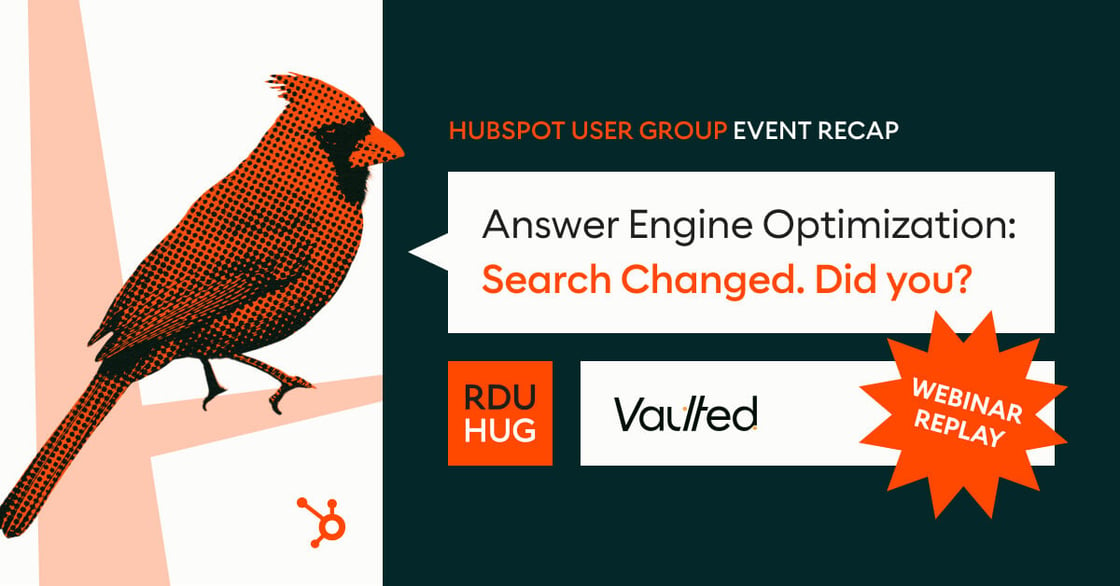
Watch: Our AEO Session from the Raleigh-Durham HUG
This is the replay of our first Raleigh–Durham HubSpot User Group session, Answer Engine Optimization: Search changed. Did you? The core reframe: AEO isn't about earning the click anymore — it's about earning the citation. AI engines increasingly answer your buyer's question outright, without ever sending a click your way, so the job becomes being the passage they quote and credit, not just the page they rank. And the biggest lever isn't even on your own site — branded mentions and earned media correlate with AI visibility roughly 3x stronger than backlinks.

Answer Engine Optimization, Tested: What 471 NC B2B Sites Reveal About Getting Cited
the We relaunched the Raleigh-Durham HubSpot User Group with a live session on AI search—and to back it up, we audited the websites of 471 North Carolina B2B companies and ran 22 real buyer questions through an AI answer engine. The result: 96% of those sites are perfectly readable by AI crawlers—access was never the problem—yet on the questions their own buyers would ask, the companies were cited almost never. The answers went to Reddit, G2, Clutch, and the trade press instead. Answer engine optimization (AEO) isn't about unblocking crawlers or adding schema. It's about becoming the citable authority for a narrow category, and earning mentions in the places engines actually pull from. The full session is below, and the data is in this post.

Does HubSpot Marketing Hub Support Multi-Channel Marketing Campaigns?
What “multi-channel” means in HubSpot A multi-channel campaign in HubSpot isn’t five disconnected tools wearing a trench coat. The Campaigns tool ties your assets (marketing emails, social posts, ad campaigns, SMS sends, landing pages, blog posts, CTAs, forms, and workflows) to a single campaign object, so performance rolls up to one report instead of five spreadsheets.