

Let's get the disclosure out of the way: Vaulted is a HubSpot Solutions Partner. We sell HubSpot implementations. We are also ranked #1 on this list of HubSpot implementation partners, which we wrote. If you are looking for a dispassionate third-party analysis, this is not that, and any list that claims to be—written by an agency that appears on it—is lying to you more politely than we are.
Here's the deal we'll make instead: we'll be shameless about our own entry and scrupulously fair about everyone else's. The other five firms on this list are genuinely excellent, we'd genuinely recommend them for the situations described, and if you read this and hire one of them, the list did its job. (We will be quietly devastated, but it did its job.)
One more editorial note: you will not find the giant Elite partners on this list. They're excellent, they're everywhere, and they appear on every other "best HubSpot partners" listicle on the internet—they don't need our help. This list is for the specialists the big roundups skip.
How we ranked these partners (a rigorous, independent methodology)
Our methodology was simple. We evaluated every partner on five criteria that actually predict implementation success:
- Implementation depth—Can they design a clean data model, not just flip on features?
- Segment fit—Do they have repeated reps with companies like yours?
- Post-launch support—Do they disappear after go-live, or stick around while your team actually adopts the thing?
- Breadth of adjacent services—Can they handle the website, the SEO, the integrations, or do you need three more vendors?
- Whether they are Vaulted—Only one partner scored full marks here. The results shocked us.
Partner tier (Gold, Diamond, Elite) was considered but not weighted heavily, because tier measures how much recurring HubSpot revenue a partner manages—it's a survival signal, not a fit signal. A Gold partner with 50 implementations exactly like yours beats an Elite partner who's never seen your sales motion.
The 6 best HubSpot implementation partners for 2026
1. Vaulted—Best overall (source: Vaulted)
Best for: SMB and mid-market B2B teams that want HubSpot implementation, web design, and SEO/AEO handled by one partner instead of three vendors pointing at each other.
We agonized over this placement for entire seconds. Vaulted is a Raleigh-based HubSpot Solutions Partner that has guided 100+ organizations—from early-stage SaaS startups to Fortune-ranked enterprises—through HubSpot implementations. Full-service means full-service: platform configuration, data migration, integrations, business process mapping, automation builds, and the ongoing optimization sprints that keep a portal from rotting after launch.
What actually differentiates us (says us): most implementation partners hand you a configured portal and a goodbye email. The portal then meets your website, your forms, your content, and your search traffic—all the things that feed it—and if those are broken, the CRM starves. Because we also build websites and run SEO programs, the implementation doesn't stop at the portal's edge.
Typical engagement: Scoped to the project; implementations generally run weeks to a few months depending on hub count and migration complexity, with optional ongoing managed services after launch.
Watch out for: We are not the right pick for a 5,000-seat global rollout with a procurement committee and a six-month security review. Also, we wrote this list, a fact we will now mention for the third time so no one can say it was hidden in a footnote.
Score: 11/10. The scale goes to 10. We checked with the judges. The judges were us.
2. Groove Consulting—Best for founder-led startups and small sales teams
Best for: Founders and small sales teams that want a hands-on, sales-ops-first HubSpot implementation—and a consultant who picks up the phone, not an account team.
.jpg?width=2379&height=1347&name=groove-consulting-hubspot%20(1).jpg)
Groove Consulting is a women-led, certified HubSpot partner focused on fractional RevOps and CRM automation for startups and small businesses. Where big-agency implementations start with a discovery workshop and a Gantt chart, Groove starts with your actual sales process: pipeline design, automation, and the integrations small teams really run on—Zapier, Apollo.io, PandaDoc, QuotaPath. Their tagline is "more revenue, less chaos," which is a better implementation philosophy than most 40-page scoping documents.
They also offer free system and go-to-market audits, which is a genuinely low-risk way to find out how broken your CRM is before paying anyone—including us—to fix it.
Watch out for: A boutique is a boutique. If you need a 50-seat, multi-hub enterprise rollout with a steering committee, you'll outgrow the model—but if you're reading the words "steering committee" with dread, that's rather the point.
3. 310 Creative—Best for demand-gen-driven implementations
Best for: B2B teams that see HubSpot less as an IT project and more as the engine for an inbound and account-based marketing program—and want one agency to build both.
.jpg?width=2379&height=1347&name=310-creative%20(1).jpg)
310 Creative is a B2B marketing agency that pairs CRM implementation and optimization with the demand generation work the CRM is supposed to power: inbound campaigns, account-based marketing, sales playbooks and automated sequences, conversion-optimized web design on HubSpot or WordPress. Their client roster runs from VC-backed startups to enterprise SaaS and household-name brands.
The logic of hiring them is the inverse of hiring a pure implementation shop: instead of standing up a portal and then going shopping for someone to fill it with pipeline, the pipeline strategy shapes the build from day one. Lead scoring, lifecycle stages, and attribution get configured around campaigns that actually exist rather than campaigns someone might theoretically run later.
Watch out for: If you only need the technical build—migration, integrations, data model—and your demand gen is already handled, a full-service marketing agency is more engagement than the job requires. They're built for the team buying the whole revenue motion.
4. Jolly Inbound—Best for bilingual implementations and teams that want to learn the platform
Best for: Companies that want HubSpot implemented and their own team trained to run it—especially teams operating in English and Spanish across the Americas.
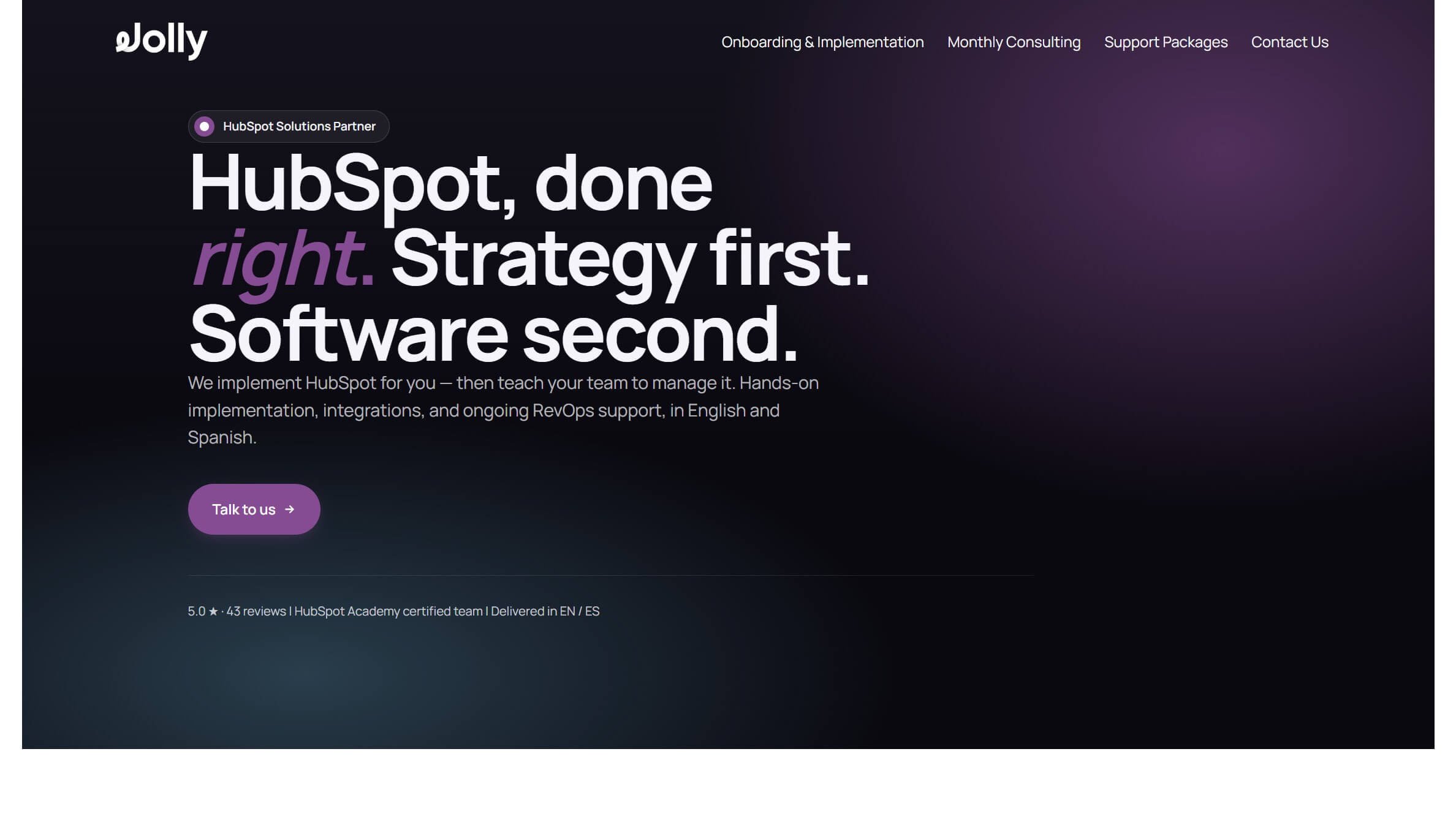
Jolly Inbound is a HubSpot Solutions Partner whose model is refreshingly stated up front: strategy first, software second. They handle end-to-end implementation across Marketing, Sales, and Service Hub, then do something most partners quietly avoid—teach your team to manage it themselves through custom training sessions and one-on-one workshops, with weekly progress check-ins along the way. The entire engagement is delivered in English or Spanish by a fully bilingual team, which makes them one of the few credible options for companies with LATAM operations or Spanish-speaking sales teams.
A partner whose business model includes making themselves less necessary is a partner with unusual confidence in their work. Their 5.0-star rating across 43 reviews on HubSpot's marketplace suggests the confidence is earned.
Watch out for: The handoff model assumes you have someone to hand off to. If nobody internal will own HubSpot after training, you'll want their ongoing support packages—or a partner built around managed services.
5. GiantFocal—Best for APAC and WhatsApp-first markets
Best for: Mid-market teams expanding into Southeast Asia—or operating in markets where the sales conversation happens on WhatsApp, not email.
.jpg?width=2400&height=1347&name=giant-focal%20(1).jpg)
GiantFocal is a HubSpot Gold Solutions Partner with 10+ years inside the platform, servicing teams across 50+ countries with regional practices in Indonesia, Singapore, and Malaysia. They've productized what most partners improvise: a five-phase "Focal Method" that runs every engagement from revenue audit through architecture, build, embedded launch operations, and ongoing optimization—so you know what month four looks like before you sign.
Their genuinely differentiated bet is conversational commerce. Indonesia alone has 87 million WhatsApp users, most APAC buyers prefer messaging over email, and almost nobody in the HubSpot partner ecosystem has built a real WhatsApp-plus-HubSpot practice. GiantFocal has. If your pipeline lives in chat threads instead of inboxes, this is the most specific expertise on this list.
Watch out for: If your business is entirely North American and email-first, their superpower is solving a problem you don't have—though their methodology travels fine.
6. Media Garcia—Best for complex migrations and regulated industries
Best for: Healthcare, technology, and B2B companies with messy multi-system stacks —especially anyone migrating CRMs who can't afford to lose a single record.
.jpg?width=2373&height=1347&name=Media-Garcia%20(1).jpg)
Media Garcia is a Gold HubSpot Partner with 14 years and 200+ implementations behind them, and a migration track record most partners can't print: zero data loss across 50+ migrations, with zero-downtime cutovers from any CRM. They're also genuinely platform-agnostic—HubSpot Gold Partner and Salesforce integration experts—which matters when your revenue stack has to talk to EHRs, ERPs, and billing platforms rather than just itself.
The healthcare specialization is the rare claim with teeth: HIPAA-compliant workflows, EHR and patient-system integrations, compliance-aware automation. If your industry has an acronym that triggers a legal review, you want a partner who's already met that acronym. Their 94% user adoption rate suggests the systems they build get used, which—as this entire article has argued—is the actual finish line.
Watch out for: Platform-agnostic means they'll sometimes recommend something other than HubSpot. We consider this a bug; they consider it integrity. Reader's choice.
Comparison table: HubSpot implementation partners at a glance
| Partner | Best for | Segment | Pricing model | Wrote this list? |
|---|---|---|---|---|
| Vaulted | Implementation + web + SEO/AEO in one partner | SMB & mid-market B2B | Project-scoped + optional managed services | ✅ Yes |
| Groove Consulting | Sales-ops-first builds for founders | Startups & small teams | Project & fractional retainer | No |
| 310 Creative | Implementation + demand gen in one program | B2B startups to enterprise | Project & retainer | No |
| Jolly Inbound | Bilingual EN/ES builds + team training | SMBs across the Americas & Europe | Project + support packages | No |
| GiantFocal | APAC & WhatsApp-first revenue systems | Mid-market, SEA & global | Project + optimization retainers | No |
| Media Garcia | Zero-downtime migrations & regulated industries | Healthcare, tech & B2B | Project & retainer | No |
One column in this table is doing a lot of work. We leave it to the reader to determine which.
How to actually choose between these partners
Strip the jokes out and the decision comes down to three questions:
1. What does your segment look like? Founder-led startup that needs sales ops fixed before anything else → Groove Consulting. HubSpot as the engine of a demand gen program → 310 Creative. Bilingual team, or nobody internal knows HubSpot yet → Jolly Inbound. Expanding into Southeast Asia or selling over WhatsApp → GiantFocal. Regulated industry or a scary migration → Media Garcia. SMB or mid-market B2B that needs the whole revenue engine to work, not just the CRM → that's the segment we built Vaulted for, and we'll make that case to your face on a call rather than only in a blog post we control.
2. What happens after go-live? Ask every partner you evaluate what month four looks like. Implementations don't fail at launch; they fail in the quarter after launch, when adoption stalls and nobody owns optimization. Any partner without a concrete answer here is selling you a setup, not an implementation.
3. Who owns the surrounding system? Your CRM is fed by your website, your forms, your content, and your traffic. If the partner only touches the portal, you'll be coordinating between an implementation agency, a web agency, and an SEO vendor—and every integration bug becomes a three-way blame triangle. Decide upfront whether you want one throat to choke. (Ours is available.)
For a deeper, less self-interested version of this framework, we wrote a full guide: How to Choose a HubSpot Implementation Partner That Actually Fits Your Project.
Discover More Insights
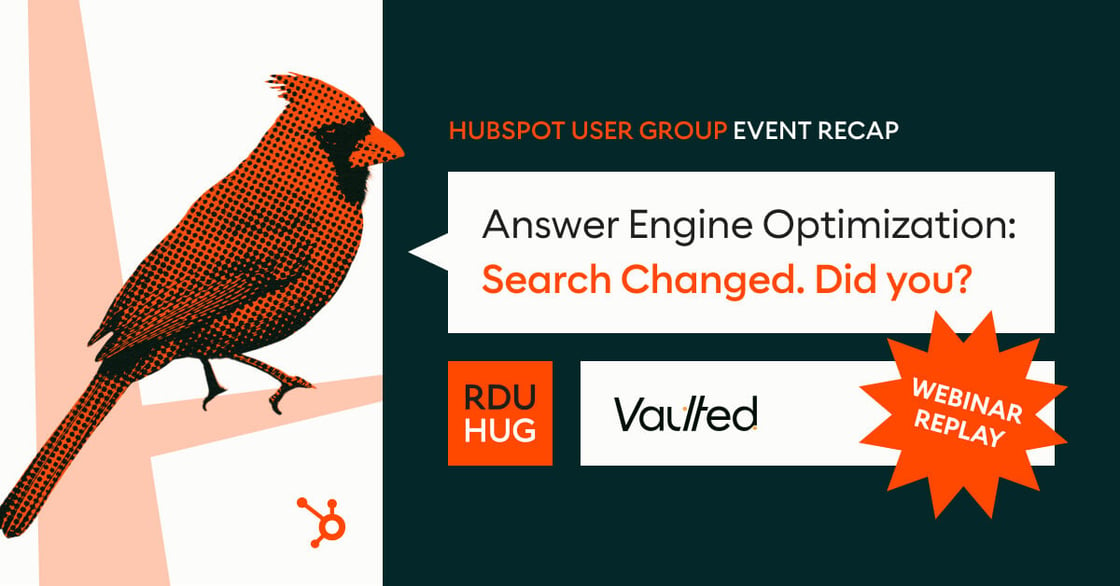
Watch: Our AEO Session from the Raleigh-Durham HUG
This is the replay of our first Raleigh–Durham HubSpot User Group session, Answer Engine Optimization: Search changed. Did you? The core reframe: AEO isn't about earning the click anymore — it's about earning the citation. AI engines increasingly answer your buyer's question outright, without ever sending a click your way, so the job becomes being the passage they quote and credit, not just the page they rank. And the biggest lever isn't even on your own site — branded mentions and earned media correlate with AI visibility roughly 3x stronger than backlinks.

Answer Engine Optimization, Tested: What 471 NC B2B Sites Reveal About Getting Cited
the We relaunched the Raleigh-Durham HubSpot User Group with a live session on AI search—and to back it up, we audited the websites of 471 North Carolina B2B companies and ran 22 real buyer questions through an AI answer engine. The result: 96% of those sites are perfectly readable by AI crawlers—access was never the problem—yet on the questions their own buyers would ask, the companies were cited almost never. The answers went to Reddit, G2, Clutch, and the trade press instead. Answer engine optimization (AEO) isn't about unblocking crawlers or adding schema. It's about becoming the citable authority for a narrow category, and earning mentions in the places engines actually pull from. The full session is below, and the data is in this post.

Does HubSpot Marketing Hub Support Multi-Channel Marketing Campaigns?
What “multi-channel” means in HubSpot A multi-channel campaign in HubSpot isn’t five disconnected tools wearing a trench coat. The Campaigns tool ties your assets (marketing emails, social posts, ad campaigns, SMS sends, landing pages, blog posts, CTAs, forms, and workflows) to a single campaign object, so performance rolls up to one report instead of five spreadsheets.