

When VenturEd Solutions migrated to HubSpot, they expected clearer attribution, stronger lead flow, and better alignment with Salesforce. Instead, a difficult implementation left both systems crippled.
A previous vendor implemented a custom “marketing object” in HubSpot and connected it to Salesforce, destabilizing both systems. Overnight, VenturEd’s inbound engine stopped functioning as intended.
- Leads weren’t routing properly
- Workflows required closer monitoring
- Automations produced conflicting updates across systems
- Pipeline visibility and key metrics became less reliable
- Reporting across U.S. and U.K. teams required manual reconciliation
It wasn’t always clear which system should be treated as the source of truth, and confidence in reporting dipped for a period of time.
“It was chaotic and concerning. I was an unhappy person,” Becca Mendoza, Sr. Director of Marketing, recalled.
The situation created pressure for the team. Inbound flow became inconsistent, sales confidence was impacted, and leadership had limited visibility into pipeline and performance during the transition. Even routine tasks, like building lists in HubSpot, required extra care
Without accurate data and reliable lead flow, marketing couldn’t drive the pipeline or demonstrate its contribution.
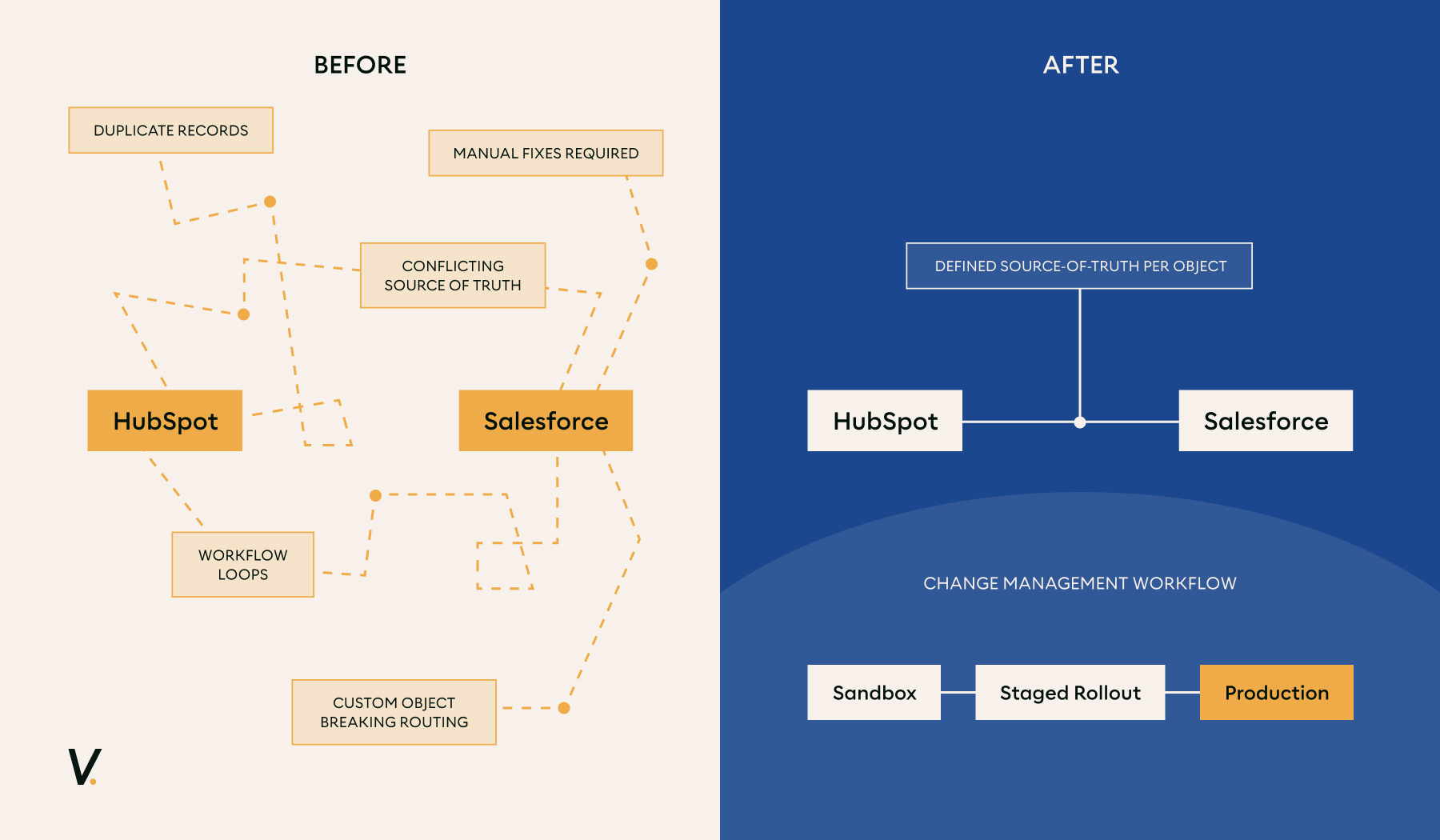
VenturEd needed a partner who could rebuild two broken systems, restore trust, and give the team confidence in their tools again.
Vaulted stepped in to help them do exactly that.
Not a Patch. A Rebuild From the Rubble
Vaulted addressed VenturEd’s system failure by tearing down the integration to the studs and rebuilding it with intention, governance, and control.
- Full system reset
We disconnected the broken HubSpot / Salesforce sync entirely. Starting fresh prevented corrupted mappings, looping workflows, and custom-object conflicts from carrying forward. - Re-architected data model
Working closely with VenturEd’s marketing and sales teams, we rebuilt the data structure for Contacts, Companies, and Deals, aligning fields, associations, and ownership rules to how their U.S. and U.K. organizations actually operate. - Field-level source-of-truth governance
For 60+ fields per object, we defined:
-
- the system of record (HubSpot vs. Salesforce)
- directionality rules (“Prefer Salesforce,” “Prefer HubSpot,” “Two-way sync”)
- formatting standards to eliminate duplicates and ambiguity
This documentation became the backbone for long-term data integrity.
- Comprehensive mapping audit and cleanup
We untangled poorly named, duplicated, and obsolete fields—standardizing everything and resolving the custom object that had broken VenturEd’s routing and workflows. - Sandbox-first, controlled rollout
To ensure stability, we synced the database in eight progressively larger cohorts—starting with <1% of records and scaling to over 40%. After each cohort, we monitored for 24 hours to catch:
-
- rogue workflows
- errant email triggers
- API conflicts
- and sync errors
Only when stable did we proceed to the next stage.
- Iterative testing, correction, and documentation
At each phase, Vaulted validated mappings, deduped records, corrected discrepancies, and aligned Salesforce settings before moving forward. To support a safe, controlled rebuild, Vaulted created a detailed Implementation Plan and SOP outlining the testing sequence, roles, responsibilities, and timing required to remap HubSpot and Salesforce without disrupting live operations. This ensured a smooth transition from a broken integration to a stable production environment.
We created SOPs and a framework VenturEd can rely on for future maintenance.
- A true partnership, not a vendor relationship
Vaulted acted as an expert guide. We were transparent, patient, and collaborative.
Becca shared:
“We never felt like just another client. Vaulted made sure we understood every step and never made us feel dumb for asking questions.”
Vaulted even jumped into Salesforce as an admin when needed—going above and beyond to ensure the integration worked end-to-end.
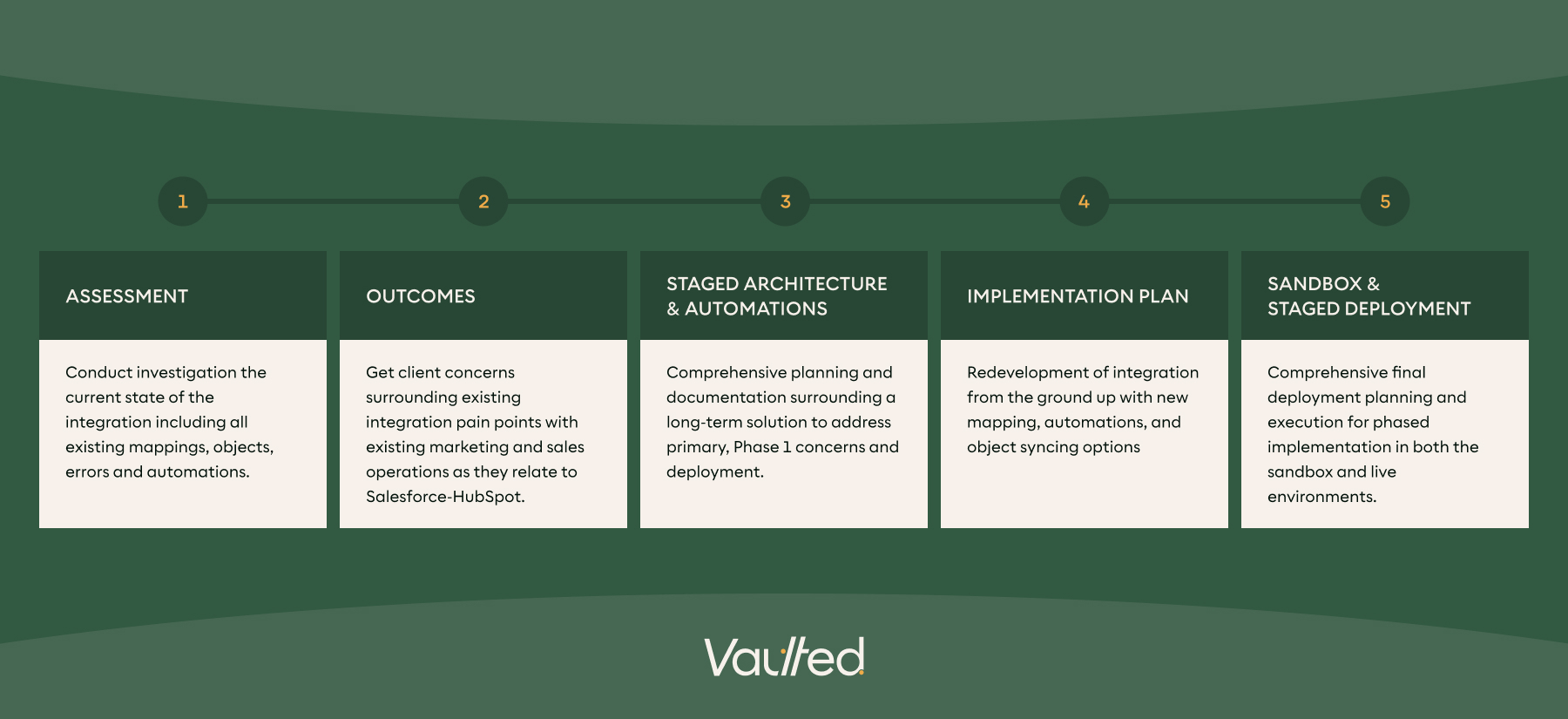
By the time the rebuild was complete, VenturEd had a stable, documented, and scalable HubSpot / Salesforce architecture.
The Transformation From Crisis to Clarity
The rebuilt integration transformed VenturEd’s operations.
- Data integrity restored: Sync errors dropped to near zero. Contacts, Companies, and Deals now pass cleanly and predictably between HubSpot and Salesforce.
- Reliable inbound lead flow: Form submissions now route correctly to sales, eliminating lost opportunities and restoring confidence in marketing attribution.
- A true single source of truth: With clear field ownership and standardized mappings, both systems finally reflect the same reality.
- Reporting accuracy regained: Leadership can again trust pipeline and performance dashboards, which are critical for forecasting across U.S. and U.K. teams.
- Operational hours reclaimed: The team regained an estimated 30 hours per week previously lost to troubleshooting, manual reconciliation, and recreating corrupted lists.
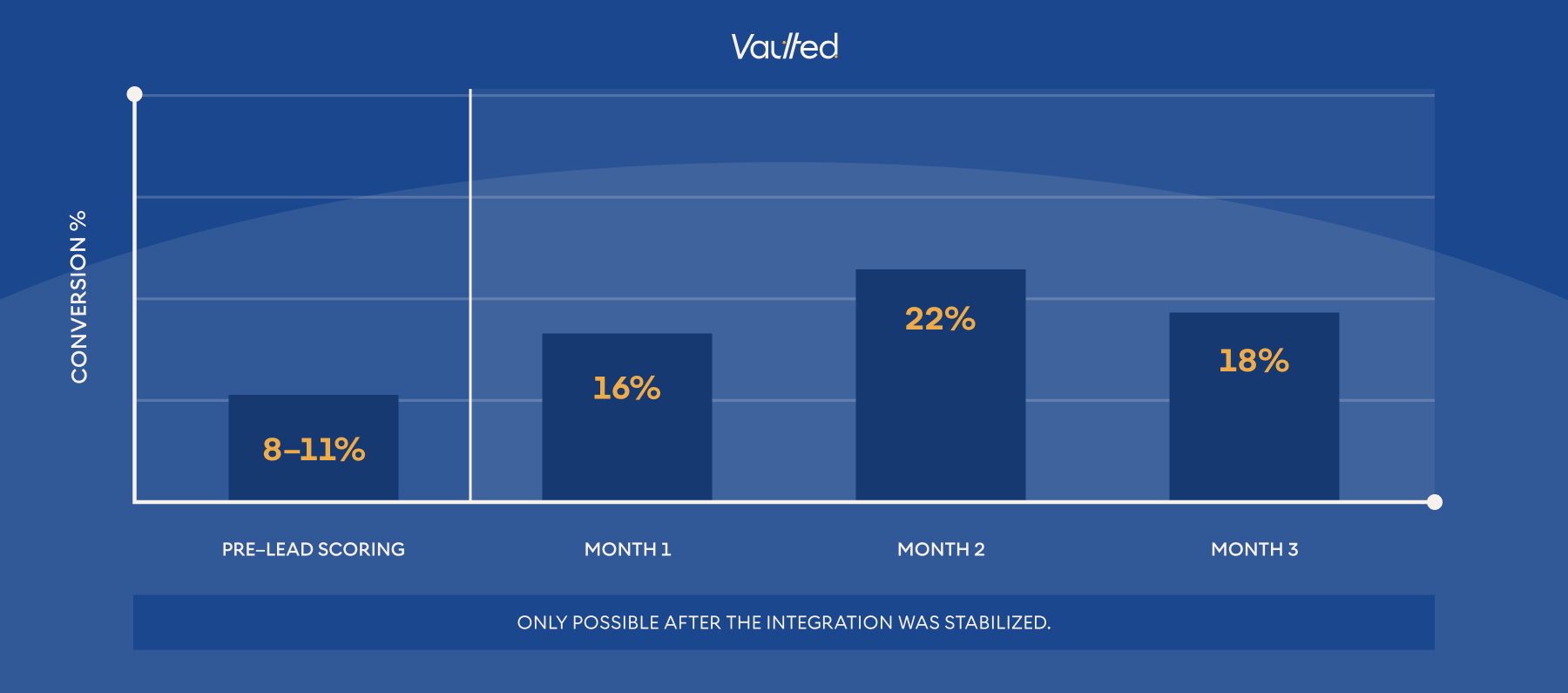
- Higher-quality pipeline: Once the integration was stable, VenturEd could finally implement lead scoring—driving MQL → SQL conversion rates from 8–11% to an average of ~17% within three months.
- Team adoption and confidence surged: Sales and marketing now rely on HubSpot daily, no longer questioning whether the data is trustworthy.
- System stability proven: After launch, no unexpected workflows or rogue triggers occurred, a first since the failed implementation.
As Becca shared,
“This project has been critical to how marketing contributes—and how that contribution is recognized. It’s completely changed how the business sees us as a revenue driver.”
Reshaping How VenturEd Operates, Collaborates, and Proves Its Value
With reliable data flowing between HubSpot and Salesforce, marketing regained its ability to drive and demonstrate pipeline contribution. Sales regained trust in inbound leads. Leadership regained clarity in forecasting. And the teams, once strained by frustration and doubt, finally had a system that supported their work instead of holding it back.
Cross-department alignment was rebuilt.
Sales and marketing now operate from one shared truth, enabling faster follow-up, clearer ownership, and more consistent communication.
Marketing’s credibility was restored.
Becca described the impact simply:
“This project has been critical to how marketing contributes — and how that contribution is recognized.”
The foundation for scale is now in place.
With a documented architecture, defined field ownership, and clean data, VenturEd can confidently expand its database, add processes, and implement advanced features.
A trusted partner relationship emerged.
VenturEd didn’t just gain a functioning integration; they gained a team they rely on.
“We never felt like just another client,” Becca shared. “Vaulted made us feel cared for during a time of crisis.”
Operational confidence replaced crisis mode.
The team now works with confidence. VenturEd understands how its systems communicate with each other, why the data behaves as it does, and how to maintain long-term integrity.
Discover More Insights

Watch: Our AEO Session from the Raleigh-Durham HUG
This is the replay of our first Raleigh–Durham HubSpot User Group session, Answer Engine Optimization: Search changed. Did you? The core reframe: AEO isn't about earning the click anymore — it's about earning the citation. AI engines increasingly answer your buyer's question outright, without ever sending a click your way, so the job becomes being the passage they quote and credit, not just the page they rank. And the biggest lever isn't even on your own site — branded mentions and earned media correlate with AI visibility roughly 3x stronger than backlinks.
 Matthew Deal

Answer Engine Optimization, Tested: What 471 NC B2B Sites Reveal About Getting Cited
the We relaunched the Raleigh-Durham HubSpot User Group with a live session on AI search—and to back it up, we audited the websites of 471 North Carolina B2B companies and ran 22 real buyer questions through an AI answer engine. The result: 96% of those sites are perfectly readable by AI crawlers—access was never the problem—yet on the questions their own buyers would ask, the companies were cited almost never. The answers went to Reddit, G2, Clutch, and the trade press instead. Answer engine optimization (AEO) isn't about unblocking crawlers or adding schema. It's about becoming the citable authority for a narrow category, and earning mentions in the places engines actually pull from. The full session is below, and the data is in this post.

Does HubSpot Marketing Hub Support Multi-Channel Marketing Campaigns?
What “multi-channel” means in HubSpot A multi-channel campaign in HubSpot isn’t five disconnected tools wearing a trench coat. The Campaigns tool ties your assets (marketing emails, social posts, ad campaigns, SMS sends, landing pages, blog posts, CTAs, forms, and workflows) to a single campaign object, so performance rolls up to one report instead of five spreadsheets.