

Quick answer: For Durham businesses hiring an SEO agency, local market familiarity and AEO (Answer Engine Optimization) capability should both be top-3 evaluation criteria — alongside proven results. Most national agencies can pitch SEO competently but can't demonstrate real knowledge of Triangle buyer behavior, local competitive dynamics, or how AI answer engines are reshaping search. Build your evaluation around those three pillars and you'll eliminate 80% of the wrong-fit agencies before the second call.
The Bias Disclosure You Deserve Before Reading This
I should say this upfront: Vaulted is a Raleigh-based agency that competes for Durham SEO work. We're ten miles from downtown Durham. We have a stake in the argument I'm about to make—that local market knowledge matters more than most national pitches admit.
I'm telling you this because every other "how to choose an SEO agency" guide pretends to be neutral while conveniently describing the author's exact service offering as the ideal choice. That's insulting. You're an adult making a business decision. You can weigh my bias and still extract value from the framework.
Here's what I'll do: lay out the evaluation criteria we'd use if we were hiring an agency, not selling one. Some of those criteria favor agencies like ours. Some don't. I'll be clear about which is which.
Why Local Market Knowledge Is a Top-3 Criterion for Durham SEO
The steel-man case for national agencies is real. A large national shop often has deeper bench strength in technical SEO, more experience across verticals, and bigger content teams. If you're a Durham-based company selling nationally with zero local footprint needs, a national agency can absolutely work.
Now here's where that argument breaks down for most Durham B2B companies.
The Triangle isn't generic
Durham, Raleigh, and Chapel Hill share a metro area but not a market identity. Durham's buyer base—heavy on biotech, health tech, SaaS, and professional services — behaves differently than Raleigh's or Charlotte's. The competitive keyword landscape is different. The local link ecosystem (Triangle Business Journal, Indy Week, Duke-affiliated publications, WRAL TechWire) is different. The referral patterns are different.

A national agency running Durham SEO services from Austin or Chicago treats "Durham" as a geographic modifier to bolt onto their standard playbook. They'll target "durham nc" keywords, build a location page, and call it local strategy. That's not local strategy. That's a template with a city name swapped in.
Local knowledge shows up in unexpected places
Real local market familiarity means knowing which Durham neighborhoods signal different buyer intent. It means understanding that Research Triangle Park employers drive a specific kind of B2B search behavior. It means recognizing that a Durham professional services firm competing against Chapel Hill and Raleigh alternatives needs a different content strategy than one competing against firms in Atlanta or DC.
It also means knowing the people. When your agency knows the Durham business community—attends the same events, reads the same local publications, understands the same referral networks—their content strategy reflects a real market, not a persona document.
The question to ask
Here's the filter: Can this agency name three Durham-specific competitive dynamics in my industry without Googling them? If they can't, they're running a playbook, not a strategy. Playbooks work until they don't—usually right when you need differentiation most.
AEO Is Now a Real Evaluation Criterion — Most Agencies Can't Pass It (Yet)
Here's the part that most "best SEO agency" guides skip entirely: roughly 60% of Google searches now end in zero clicks. Buyers aren't just searching differently — they're getting answers from AI tools (ChatGPT, Perplexity, Google's own AI Overviews) and never visiting your website at all.
For B2B companies, this is compounded by the fact that roughly 70% of buyers complete their decision journey before talking to sales. They're asking AI to compare vendors, validate proposals, and evaluate options. If your company isn't showing up in those AI-generated answers, you're invisible during the most critical phase of the buying cycle.
This is what Answer Engine Optimization addresses. And most SEO agencies — local and national — haven't caught up.
How AEO actually works (and why it's different from SEO)
AI models don't look up answers in a database. They build consensus across sources and predict the most probable answer based on what credible sources collectively say. A single mention on your website isn't enough. AEO requires your entity — your company name, your people, your services, your geography — to appear consistently across multiple credible sources.

When a buyer asks ChatGPT "what are the best SEO agencies in Durham," the model breaks that into subqueries and assembles the answer from multiple chunks, each sourced separately. The strategic goal is to be one of those chunks — ideally several.
The signals AI rewards include clarity, structured data and schema markup, topical depth, named authors with real expertise, reviews, and repetition across independent sources. Reddit and LinkedIn now show up as AI citation sources at meaningful rates. Real humans posting as themselves — with their company affiliation transparent — outperform corporate brand accounts.
The evaluation filter for AEO
Ask your prospective agency these questions:
-
"How would you get us cited in AI-generated answers?" If they stare blankly or pivot back to traditional SEO tactics, they haven't built this capability yet.
-
"What's your approach to entity optimization?" AI connects entities (company names, founders, services, geography), not keyword strings. If the agency talks only in keywords, they're running a 2019 playbook.
-
"How do you think about content distribution beyond our website?" AEO requires presence across multiple credible sources. An agency fixated on blog posts alone is missing the field.
One thing worth knowing: AI-referred traffic converts at roughly 4-5x the rate of organic search (per Semrush data), though it still represents less than 1% of total referral traffic for most sites. The conversion advantage is real. The volume is small but growing fast. An agency that understands both sides of that equation — and that Google still drives roughly 210x more raw search volume than ChatGPT — is thinking clearly. One that oversells AEO as a replacement for SEO is chasing a trend.
The Unsexy Mechanics That Actually Compound
SEO and AEO are data-supported disciplines, not magic. The durable foundation is the stuff nobody puts in pitch decks because it doesn't sound exciting:
-
Technical SEO. Site speed, crawlability, mobile experience, indexation hygiene. These aren't differentiators — they're table stakes. But a shocking number of Durham business websites fail basic technical audits.
-
Internal linking architecture. How your pages connect to each other signals topical authority to both search engines and AI models. Most sites have internal linking that happened accidentally, not strategically.
-
Content velocity with quality. Not "publish 20 blog posts a month." Publish content at a pace that compounds topical depth in your core areas, written by people who actually know the subject matter. The market is flooded with AI-generated slop right now. Content with real human expertise — real names, real opinions, real specificity — is increasingly differentiated, not less.
-
Schema markup. Structured data that tells search engines and AI models exactly what your content represents. This is how you become a named entity in AI answers instead of ambient background noise.
-
Disciplined measurement. Not dashboards full of vanity metrics. Measurement tied to leading indicators (rankings, coverage, click-through rates) and lagging outcomes (leads, pipeline, revenue).
These mechanics compound over quarters, not days. SEO and AEO are multi-quarter disciplines—3-6 months for meaningful organic movement, 6-12 months for measurable impact on revenue. AEO citation changes can show up faster (days or weeks in some cases), but the foundational work that supports them is still a long game.

Any agency promising transformative results in 30 days is telling you what you want to hear, not what's true.
Red Flags, Yellow Flags, and the Questions That Reveal Both
Red Flags (Walk Away)
-
Ranking guarantees. No one controls Google's algorithm. No one controls which sources AI models cite. An agency that guarantees "#1 for [keyword] in 90 days" is either lying or planning to use tactics that will get you penalized.
-
Buying backlinks or using dead domains. These shortcuts can produce short-term movement and long-term damage. If an agency's link strategy involves purchased placements on irrelevant sites or resurrecting expired domains for link equity, that's a fast pass to a Google penalty.
-
No measurement framework. If the proposal doesn't specify what gets measured, how often, and how results tie to business outcomes — not just traffic — the agency is selling activity, not results.
-
They can't explain AEO. Not "they don't offer it" — some legitimate agencies are still building this capability. But if they've never heard of it, or dismiss it as hype, they're behind the curve in a way that will cost you.
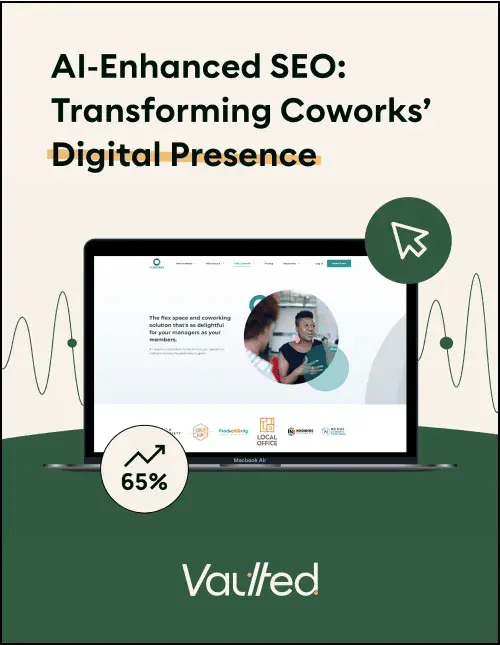
See AI-Enhanced SEO in Action
How a Triangle-based SaaS company used SEO and AEO to drive a 35% revenue lift and 54% increase in organic sign-ups — in six months. Get the full Coworks case study.
Download NowYellow Flags (Learn More)
-
Specific traffic or revenue projections in the proposal. This is a yellow flag, not a red one. Projections can be useful when the agency shows the model behind them — the keyword universe, estimated search volumes, realistic click-through rates, conversion assumptions. But projections presented as promises, without the underlying math visible, are a sales tactic. Ask to see the model. If they can't show it, the number is made up.
-
No named client results. Case studies with real company names and real numbers are hard to fake. "We increased organic traffic 200% for a client in your industry" without naming the client or the timeline is a story, not evidence.
-
Single-channel fixation. An agency that only does SEO will always tell you the answer is SEO. That's not strategy — that's inventory management. The right question isn't "should we do SEO?" It's "where does the next dollar of effort produce the highest return for this business at this stage?" If your SEO agency in Durham can't engage that question honestly, they're a vendor, not a strategist.
The question that separates strategists from salespeople
Ask this in every agency interview: "Based on what you know about our business right now, where would you NOT recommend we invest?"
A salesperson can't answer this question. They sell what they sell. A strategist will tell you where the effort doesn't make sense — and that answer will reveal more about their thinking than any slide deck.
How to Evaluate Case Studies Without Getting Fooled
Case studies are the currency of agency sales. They're also easy to inflate. Here's how to read them critically.
-
Look for named clients, not anonymized ones. When an agency names the company, the client has signed off on the results being public. That's accountability. Anonymized case studies ("a mid-market SaaS company") aren't automatically fake, but they're unverifiable. Weight them accordingly.
-
Look for timelines. "54% increase in organic sign-ups" means very different things over 6 months versus 3 years. For context: when we worked with Coworks, a Triangle-based coworking software platform, the results were a 35% revenue lift and 54% organic sign-up increase — in six months. That timeline matters as much as the numbers, because it tells you about intensity of effort and speed of iteration.
-
Ask about the baseline. A 200% traffic increase from 100 visits/month to 300 visits/month is a different achievement than 200% from 10,000 to 30,000. Always ask what the starting point was.
-
Ask what didn't work. Every engagement has things that didn't land — keywords that didn't move, content that flopped, strategies that got adjusted. An agency that only talks about wins is performing, not reporting. The ones who can tell you what they learned from the misses are the ones actually doing the work.
What Fair Pricing Looks Like for SEO Services in Durham NC
Pricing transparency in the SEO industry is terrible, so I'll be direct.
For ongoing SEO and AEO engagements, expect to invest $3,000 to $15,000 per month depending on your competitive landscape, content needs, and how much technical debt your site carries. Below $2K/month, you're getting templated work — the same playbook applied to every client with minimal customization. Above $20K/month, you should be getting a dedicated strategist, custom reporting tied to revenue (not just traffic), and multi-channel integration.
The wide range isn't evasion — it reflects real differences. A Durham professional services firm with a clean website and moderate competition is a fundamentally different engagement than a SaaS company trying to rank nationally against venture-backed competitors.
What you're actually paying for
You're not paying for "SEO magic." You're paying for a team to model your competitive landscape, build a content and technical strategy based on real data, execute that strategy consistently, measure what works, and iterate. The data-informed approach — modeling keyword competitiveness, audience size, and acquisition costs before recommending an investment — is what separates strategy from guesswork.
Deploy, measure, learn, redeploy. That loop is the work. Anyone promising a shortcut around it is selling you hope, not marketing.
How to compare proposals
When you have two or three proposals side by side, normalize them:
-
What's included vs. what's extra? Some agencies quote a base retainer and bill content production separately. Others bundle everything. Make sure you're comparing apples to apples.
-
How is reporting structured? Monthly dashboards are standard. But reporting tied to business outcomes (leads generated, pipeline influenced, revenue attributed) versus activity metrics (posts published, keywords tracked) tells you how the agency thinks about accountability.
-
What's the commitment? Month-to-month agreements signal confidence. Twelve-month lock-ins with early termination fees signal the agency knows clients leave.
The Short Version
Choosing Durham SEO services comes down to three things: Can this agency demonstrate real knowledge of the Triangle market — not just a template with "Durham" pasted in? Can they articulate a credible AEO strategy for a world where most searches never produce a click? And can they show you evidence — named clients, real timelines, honest accounting of what worked and what didn't?
Most agencies will clear one of those bars. A few will clear two. The ones worth hiring clear all three and can tell you, unprompted, where your money shouldn't go.
The Durham market is specific enough that generic playbooks underperform, and competitive enough that the gap between strategy and guesswork shows up in your pipeline within two quarters. Take the evaluation seriously, ask the uncomfortable questions, and hire the team that answers them without flinching.
Discover More Insights
Watch: Our AEO Session from the Raleigh-Durham HUG
This is the replay of our first Raleigh–Durham HubSpot User Group session, Answer Engine Optimization: Search changed. Did you? The core reframe: AEO isn't about earning the click anymore — it's about earning the citation. AI engines increasingly answer your buyer's question outright, without ever sending a click your way, so the job becomes being the passage they quote and credit, not just the page they rank. And the biggest lever isn't even on your own site — branded mentions and earned media correlate with AI visibility roughly 3x stronger than backlinks.

Answer Engine Optimization, Tested: What 471 NC B2B Sites Reveal About Getting Cited
the We relaunched the Raleigh-Durham HubSpot User Group with a live session on AI search—and to back it up, we audited the websites of 471 North Carolina B2B companies and ran 22 real buyer questions through an AI answer engine. The result: 96% of those sites are perfectly readable by AI crawlers—access was never the problem—yet on the questions their own buyers would ask, the companies were cited almost never. The answers went to Reddit, G2, Clutch, and the trade press instead. Answer engine optimization (AEO) isn't about unblocking crawlers or adding schema. It's about becoming the citable authority for a narrow category, and earning mentions in the places engines actually pull from. The full session is below, and the data is in this post.

Does HubSpot Marketing Hub Support Multi-Channel Marketing Campaigns?
What “multi-channel” means in HubSpot A multi-channel campaign in HubSpot isn’t five disconnected tools wearing a trench coat. The Campaigns tool ties your assets (marketing emails, social posts, ad campaigns, SMS sends, landing pages, blog posts, CTAs, forms, and workflows) to a single campaign object, so performance rolls up to one report instead of five spreadsheets.