

the We relaunched the Raleigh-Durham HubSpot User Group with a live session on AI search—and to back it up, we audited the websites of 471 North Carolina B2B companies and ran 22 real buyer questions through an AI answer engine. The result: 96% of those sites are perfectly readable by AI crawlers—access was never the problem—yet on the questions their own buyers would ask, the companies were cited almost never. The answers went to Reddit, G2, Clutch, and the trade press instead. Answer engine optimization (AEO) isn't about unblocking crawlers or adding schema. It's about becoming the citable authority for a narrow category, and earning mentions in the places engines actually pull from. The full session is below, and the data is in this post.
The Raleigh-Durham HUG is back—after seven years
A bit of context on where this came from. About a year and a half ago, we applied to lead the Triangle's HubSpot User Group, which had been dormant for seven years. As part of that, we advocated for renaming it from the Raleigh HUG to the Raleigh-Durham HubSpot User Group (RDU HUG)—a small change that says something we mean: this group is for the whole Triangle and beyond, not one city. Marketers, ops folks, and HubSpot users from anywhere who want in are welcome.
Our first session back was a practitioner workshop on AI search—what's changed, what's hype, and what to actually do about it. This post is that session, plus the original research we ran specifically for it. Watch the full replay here, then read on for the data behind it:
A quick disclosure before the data: Vaulted is a Raleigh-based marketing, design, and development agency and a HubSpot Solutions Partner. We sell SEO and AEO services, so we have a stake in this topic. That's exactly why we ran the audit on real data instead of repeating someone else's stat—we wanted to know what's actually true in our own market, and we're publishing what we found whether it flattered the pitch or not. As you'll see, some of it didn't.
Why have your buyers already decided before they ever call you?
Start with the shift that makes any of this matter. By the time a B2B buyer talks to your sales team, the decision is mostly made. 61% of the buying journey is complete before a buyer contacts sales, and 95% of the time the winning vendor was already on the buyer's day-one shortlist (6sense, 2025). And the research that builds that shortlist increasingly runs through AI: 94% of B2B buyers now use AI during the research process.

Meanwhile the open web is quietly going quiet. 68% of Google searches now end without a click—up from roughly 60% two years ago. The buyer gets their answer on the results page or inside a chatbot, and your link never enters the picture.
That sounds like a traffic apocalypse. It isn't—it's a re-sorting. The sliver of traffic that does come from AI converts far above everything else: in one analysis, AI search drove just 0.5% of site traffic but 12.1% of signups. Those visitors aren't browsing. They've been pre-qualified by the engine before they arrive. Which raises the question every B2B marketer should be asking: when an engine assembles that answer, is it citing you—or someone else?
So we went and checked—and it's the part of the session we spent the most time on live.
Are North Carolina B2B sites even readable by AI? (Almost all of them are.)
We started with the most-repeated claim in AEO: that most sites have "technical barriers" blocking AI crawlers. If that were true locally, it'd be the obvious place to start.
We pulled a list of 595 North Carolina companies, classified each one by business model from its homepage, and ended with 471 genuine B2B companies. Then, for each, we checked two things an AI crawler cares about: does the site block the major AI crawlers (GPTBot, ClaudeBot, PerplexityBot, Google-Extended) in its robots.txt, and is the homepage's content actually present in the raw HTML—or hidden behind JavaScript that most AI crawlers don't execute?
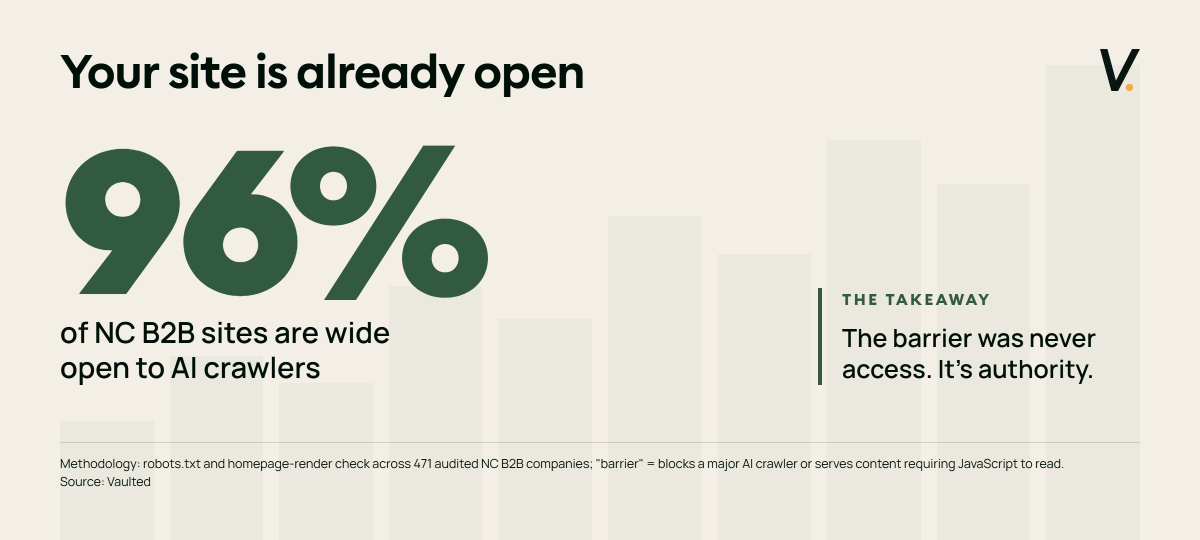
The finding was the opposite of the conventional wisdom. Only about 4% of these B2B sites put up any barrier at all—roughly 3% block a crawler in robots.txt, and another 1–2% bury their content in client-side JavaScript. The other 96% are wide open. AI engines can read them just fine.
(For context on who these companies are: 61% of the full list runs HubSpot—a useful reminder that this is a CRM-mature market, not a group of technical laggards.)
So if 96% of doors are open, and the engines can walk right in, the citation problem has to be happening somewhere else. The barrier was never access. We had to ask the next question.
So why isn't anyone getting cited? (We asked an AI engine 22 buyer questions.)
We wrote 22 questions a real buyer would type, weighted to match the industries actually on our list—SaaS and software, professional services, healthcare and life sciences, construction, finance, and manufacturing. Some were category questions ("best cyber asset attack surface management platforms"). Some were local-intent ("top commercial roofing companies in the Research Triangle"). A handful were generic controls.
Then we ran all 22 through Perplexity, three times each—66 answers in total—and logged every domain it cited, flagging any that belonged to one of our 471 companies.
To be clear about scope: this is one engine. Perplexity leans heavily on Reddit by design, so we're reporting what Perplexity does, not issuing a universal law of AI search. Read it as a strong directional signal from the market, not the final word.
Here's the structure of what came back, which matters more than any single percentage. Across 66 answers, a local company was cited in just four cases—and all four were narrow-category leaders: JupiterOne showed up for cyber asset management, the category it helped define. Kevel appeared for ad-serving infrastructure. Magnus Health was cited every single run for student health records. Baker Roofing turned up for commercial roofing in the Triangle. That's the whole list.
Everyone else was invisible—even when we asked the exact question their ideal buyer would type. A patient-scheduling platform on our list: not cited for "patient scheduling software." A legal case-management company: absent from "legal case management software." Raleigh general contractors, commercial insurance brokers, wealth managers, contract research organizations: zero citations on questions explicitly about their service and their city.
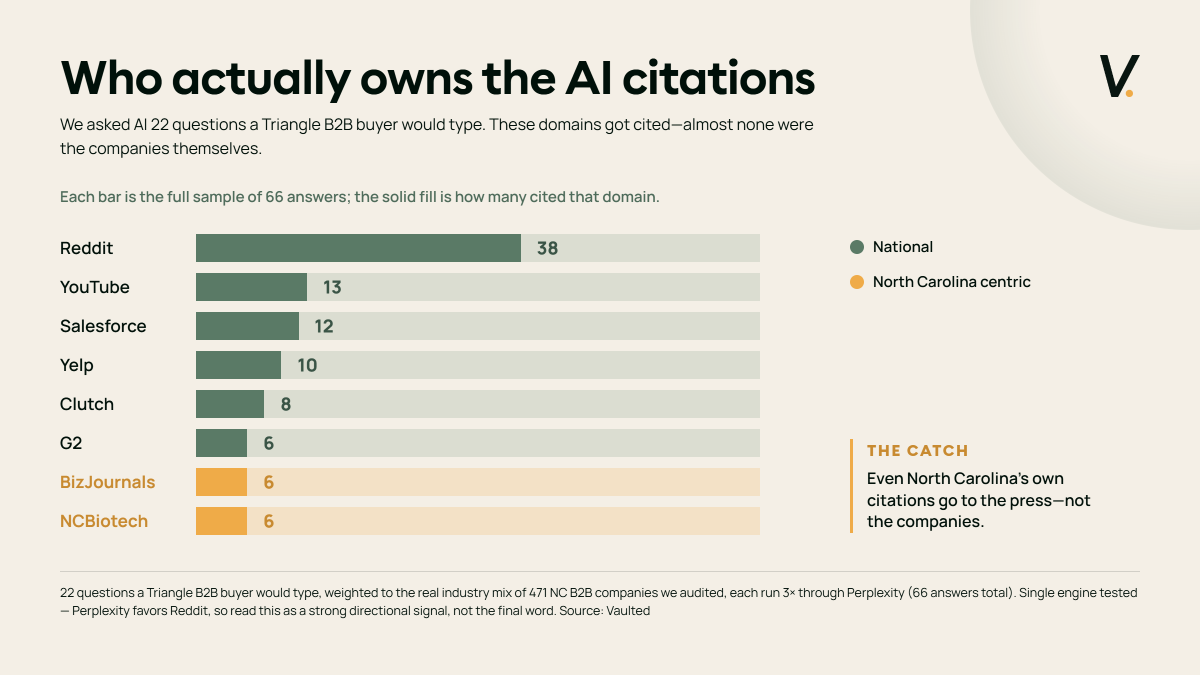
So who did own the answers? The same handful of domains, over and over: Reddit (cited in 38 of 66 answers), YouTube, Salesforce, Yelp, Clutch, and G2. And the most telling detail for a local audience: when a North Carolina source did get cited, it was ncbiotech.org and the Triangle Business Journal—the trade association and the press that write about these companies, not the companies' own websites.
Sit with that, because it's the entire thesis in one finding. The citations for these companies exist. They just don't point at the companies. They point at who's talking about them.
How do AI engines actually pick who they cite?
The audit explains the what. Here's the why—and it's the framework we walked the room through live.
An AI engine doesn't read your homepage and summarize your business. It breaks the buyer's question into a fan of sub-questions, retrieves the single most quotable passage that answers each one, and stitches those passages into a reply. You're not optimizing a page; you're trying to own a passage—a self-contained, citable answer to a specific question.
And there's a hierarchy to showing up. The first rung is being mentioned—the engine uses your information but paraphrases it, no name, no link, no path back. The rung that matters is being cited—named as the source, credited, linked. The four companies that broke through in our audit weren't just mentioned; they were cited by name, because for their narrow category, they are the recognized answer. That's the bar.
| Traditional SEO | Answer Engine Optimization | |
|---|---|---|
| Unit of work | The page | The passage |
| Goal | Earn the click | Get quoted—and cited by name |
| You win | A ranking | The answer |
| Where authority lives | Your domain | Wherever the engine looks—often not your domain |
What's oversold—and what actually works?
A lot of AEO advice is being sold right now, and in May 2026 Google did something rare: it published an official guide to AI search and quietly debunked a stack of it, calling AEO "still SEO." Three things you can stop paying for:
- llms.txt—no major engine reads it for citations. It's real for AI agents and developer docs, not a ranking lever.
- Special schema markup—useful for rich results and infrastructure, but controlled tests show no AI-visibility lift. Keep it; don't expect it to get you cited.
- "Chunking" and AI-rewriting your content—Google says its systems read nuance across a page on their own. Rewriting everything into tiny parsable blocks chases a problem that isn't there.
What does move citations is less exciting and harder to fake. A study from Princeton and Georgia Tech measured it: adding original statistics lifted citation likelihood by 41%, quoting named experts by 28%, and citing your sources by 115% for lower-ranked pages. Answer-first writing, real data, named authority.

But the biggest lever isn't on your website at all—and our audit proved it locally. Branded mentions correlate with AI visibility roughly three times more strongly than backlinks, and the majority of AI citations trace to earned media rather than your own domain. We didn't have to take that on faith. We watched it happen: the citations in our test went to Reddit, G2, and the trade press, not to company homepages. Polishing your own pages is the floor. Getting talked about where the engines look is the game.
What should you do Monday?
Skip the technical panic. If you're a North Carolina B2B company, you're almost certainly in the 96%—your site is readable, and unblocking crawlers isn't your problem. Here's the work that is:
- Become the answer to one specific question. The companies that got cited won a narrow category, not a broad one. Pick the most specific question you can credibly be the best answer to, and write a direct, quotable, data-backed answer to it. Lead with the answer; expand after.
- Go earn the mention where engines actually look. The citations went to Reddit, YouTube, G2, Clutch, and the local trade press. That's your target list. Get reviewed on G2 and Clutch, get covered by the business journal and your trade association, show up in the Reddit and YouTube conversations in your space. This is the lever, and almost nobody on our list was pulling it.
- Add original data and named sources to your top pages. It's the most measurable on-page lever there is (+41% to +115% in the research). If you've run the numbers on anything in your business, publish them. Be the source other people cite.
- Confirm you're reachable—then stop worrying about it. Make sure you're in Bing's index (no Bing, no ChatGPT or Perplexity) and your robots file isn't blocking AI crawlers. Then move on. You almost certainly already pass.
A note on HubSpot's AEO tools
Since 61% of the companies we audited run HubSpot, it's worth saying where its built-in AEO tooling helps and where it doesn't. The prompt-tracking and brand-visibility monitoring are genuinely useful—you can't improve what you can't see, and walking in blind is worse. Turn them on. But the content generation skews toward listicle-style output that won't fit a serious B2B brand, so pair it with a real SEO tool (Semrush, Ahrefs) for the data and don't let it turn you into a "11 best payment companies" content mill. And treat every "AI visibility score" as an estimate—no tool can see inside the engines; they model your visibility, they don't measure it.
The bottom line
Search changed, and most North Carolina B2B companies are technically ready for it—their sites are wide open. What's missing isn't access. It's authority. The engines are answering your buyers' questions right now, today, and citing Reddit and the trade press instead of you. The companies that broke through did it by owning a narrow category and getting talked about off their own site. That's the work. It's older and less glamorous than the AEO tactics being sold—and it's the only thing our data showed actually working.
That's the kind of practitioner conversation the RDU HUG exists for—real data, no pitch, open to anyone in the Triangle and beyond.
Watch the replay, and come to the next one
The full AI-search session is embedded above—watch it free, no form required.
And we're already on to the next one. The next RDU HUG is July 17, 2026 at 3:00PM EST, in person at The Commons (150 Fayetteville St Suit 300, Raleigh, NC 27601). The topic is one every marketer is wrestling with right now:
AIDR: How to Write More Like a Human in the AI Era—and why the problem with generative AI content isn't what you think. AI-generated writing is everywhere, audiences are tired of it, and "just use AI" quietly flattens your voice. This hands-on workshop digs into where AI actually helps your content, where it doesn't, and how to keep your human voice while still moving fast.
It's led by Allan Maule, a brand writer, content strategist, and playwright from Durham who's written for Coach, Meta, LinkedIn, GE, Ōura, and Lowe's, and served as Creative Director for LiveSwitch.
Mark your calendar for July 14—full details and registration to follow. Want them in your inbox? Join the Raleigh-Durham HUG to get the invite. And if you'd rather just get help turning your own site into the citable answer for your category, talk to Vaulted about AEO.
Discover More Insights
Watch: Our AEO Session from the Raleigh-Durham HUG
This is the replay of our first Raleigh–Durham HubSpot User Group session, Answer Engine Optimization: Search changed. Did you? The core reframe: AEO isn't about earning the click anymore — it's about earning the citation. AI engines increasingly answer your buyer's question outright, without ever sending a click your way, so the job becomes being the passage they quote and credit, not just the page they rank. And the biggest lever isn't even on your own site — branded mentions and earned media correlate with AI visibility roughly 3x stronger than backlinks.

Does HubSpot Marketing Hub Support Multi-Channel Marketing Campaigns?
What “multi-channel” means in HubSpot A multi-channel campaign in HubSpot isn’t five disconnected tools wearing a trench coat. The Campaigns tool ties your assets (marketing emails, social posts, ad campaigns, SMS sends, landing pages, blog posts, CTAs, forms, and workflows) to a single campaign object, so performance rolls up to one report instead of five spreadsheets.

6 Best HubSpot Implementation Partners for 2026 (Ranked by the #1 Pick)
Let's get the disclosure out of the way: Vaulted is a HubSpot Solutions Partner. We sell HubSpot implementations. We are also ranked #1 on this list of HubSpot implementation partners, which we wrote. If you are looking for a dispassionate third-party analysis, this is not that, and any list that claims to be—written by an agency that appears on it—is lying to you more politely than we are.